Ocean Life Coloring Book Pages for Kids
A Designer’s First Glance: Whimsy, Flow, and Quiet Confidence
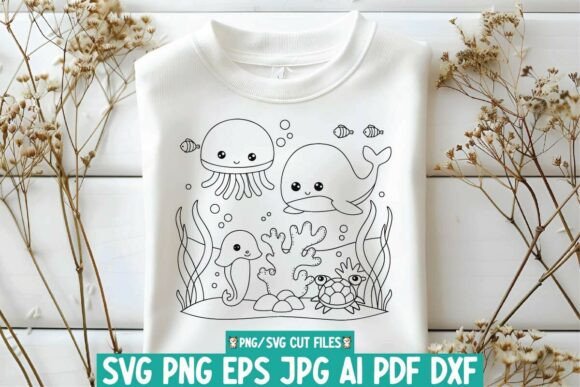
Opening Ocean Life Coloring Book Pages for Kids, I didn’t see just outlines—I saw stitch paths. The collection breathes with gentle rhythm: a sea turtle’s flippers curve with natural ease, coral branches fan out without overcrowding, and a smiling octopus balances detail with openness. There’s no forced complexity—just clean, confident line work that invites color *and* thread. It’s not “cute overload.” It’s calm, curious, and quietly sophisticated—exactly the kind of visual tone that translates well into embroidery without needing heavy editing.
Where This Design Lives Best in Real Embroidery Projects
I recently prepped a custom embroidered tote bag for a local children’s bookstore—soft canvas, medium-weight stabilizer, 4” hoop. I tested three designs side by side, and Ocean Life Coloring Book Pages for Kids stood out immediately—not because it was flashiest, but because its spacing and line weight held up at 3.5” wide. The seahorse motif, with its looping tail and subtle scale texture, stitched cleanly in satin and fill stitches without bleeding or crowding. Customers responded to the warmth and clarity—not “busy,” not “bare,” just *right*.
This design shines in soft-touch applications: baby onesies (gentle curves avoid seam stress), linen pillow covers (line weight reads beautifully against natural texture), kitchen tea towels (the open layout prevents stiffness), and unstructured aprons (no dense fill areas to hinder drape). For Etsy sellers and small shop owners, it’s ideal for boutique nursery decor bundles—pair a stitched whale motif on a cotton blanket with matching printable wall art from the same collection. It also works well as an embroidered patch when digitized with moderate stitch density—clean edges hold shape after washing, and the organic shapes don’t fight the fabric grain.
Where to Pause—and Why
Not every surface welcomes this design equally. On stretchy fabrics like ribbed knit sweatshirts, the finer interior lines (like jellyfish tentacles or starfish ridges) need extra stabilization—light tear-away alone won’t cut it. On dark fabric, those delicate outlines can disappear unless you use high-contrast thread (think bright aqua on navy, not pale yellow). And on curved surfaces—caps or toddler beanies—the outermost elements (e.g., the tip of a dolphin’s snout or seaweed fronds) may distort if hooped too tightly or digitized without slight contour compensation.
Also worth noting: while the coloring book style suggests simplicity, some pages include light internal detailing—tiny bubbles, faint wave lines, or subtle shell textures. These translate beautifully in fill stitch on stable cotton, but they’ll vanish on thin, loosely woven muslin or overly textured burlap. If you’re planning a commercial embroidery run for a craft fair line, test those details on your exact fabric-and-stabilizer combo first. Don’t assume “coloring page = easy stitch.” It’s easy *to adapt*—but only if you respect its structure.
What It Adds to Your Finished Product—Beyond Aesthetics
Ocean Life Coloring Book Pages for Kids quietly lifts perceived value. Because the lines are intentional—not rushed or pixelated—it reads as handmade with care, not mass-produced clip art. That builds customer trust, especially for personalized gifts (a monogrammed towel + ocean motif feels cohesive, not slapped together). For apparel decorators, it supports brand consistency: soft, nature-based, inclusive imagery that appeals across age groups—toddlers, teachers, eco-conscious teens. And for digital product sellers, these pages serve double duty: as embroidery-ready assets *and* as printable mockups for Etsy listings—giving buyers immediate context for how the design lives off-screen.
Practical Notes Every Embroidery Designer Should Run Through
- Always test on scrap fabric first—especially if using textured or dark material. What reads as clear on screen may blur under thread.
- Review stitch density before scaling. Enlarging beyond 120% risks overfilling delicate zones; shrinking below 70% may collapse fine lines.
- Confirm hoop size compatibility. Most motifs fit comfortably in a 4×4 hoop—but check the largest element (e.g., full-page coral reef layout) before committing to a production run.
- Inspect small details at actual stitch size. Tiny eyes, gills, or bubble dots should be large enough to register clearly—no smaller than 1.2mm in final output.
- Test black-and-white mockups to assess contrast and hierarchy—this reveals whether the design holds visual weight without color cues.
- Compare light vs. dark fabric backgrounds in your embroidery software preview. Some outlines need boldening for low-contrast situations.
- Use appropriate stabilizer: cutaway for knits, tear-away for stable wovens, and lightweight mesh for sheer layers like baby swaddles.
- Verify licensing terms before selling finished items or bundling as part of a digital embroidery file pack. Ocean Life Coloring Book Pages for Kids is listed under Coloring Pages Amp—review their usage policy carefully if you plan commercial resale of stitched goods or derivative design assets.
Final Thought: It’s Not Just a Pattern—It’s a Starting Point
As someone who’s digitized hundreds of hand-drawn motifs, I appreciate how Ocean Life Coloring Book Pages for Kids respects the maker’s time and intent. It doesn’t demand excessive cleanup. It doesn’t beg for filters or effects. It offers breathing room—for thread, for fabric, for the person holding the hoop. Whether you’re stitching a holiday gift for a marine biologist’s kid, building a summer-themed small shop product line, or creating a signature embroidered patch for your craft business, this collection delivers quiet reliability. Not flashy. Not fussy. Just ready—thoughtfully, honestly, and stitch by stitch.